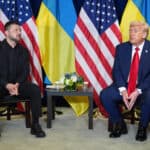
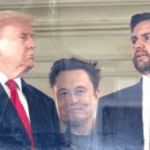
Just one year after returning to the White House, Donald Trump has left a mark on the United States and the world that few modern presidents can rival. Since assuming power on January 20, 2025, Trump has pursued a fast-paced, uncompromising agenda that has transformed domestic policy, disrupted global trade, and redefined international alliances.
From the U.S. southern border to NATO summits, the so-called “Trump effect” has been immediate and far-reaching. Through a wave of executive orders and hardline policies on immigration, trade, energy, and foreign affairs, Trump has imposed his vision of strength, sovereignty, and national interest—often at the cost of long-standing norms.
Immigration First: Borders, Enforcement, and Deportations
On his first day in office, Trump declared a national emergency over migration, citing more than 13 million irregular border crossings during the previous Democratic administration. The response was swift: military deployment along the U.S.–Mexico border, suspension of entries from the southern border, and the expansion of a physical border wall.
Under Operation Aurora, the administration launched mass deportations, prioritizing criminals and gang members. Trump also signed the Laken Riley Act, targeting crimes committed by undocumented immigrants, and moved to block automatic citizenship for children born to undocumented parents. Supporters argue these measures have restored order and security; critics warn of humanitarian and legal consequences.
Energy, Climate, and the End of Green Commitments
One of Trump’s most controversial decisions was withdrawing the United States from the Paris Climate Agreement and the World Health Organization. Declaring an “energy emergency,” he reopened Alaska to drilling, rolled back emissions regulations, and eliminated incentives for electric vehicles.
While fossil fuel production has surged and regulations have eased, climate advocates point to serious consequences. The U.S., responsible for roughly 13% of global emissions, has slowed international climate action. Around $11 billion in climate funds aimed at disadvantaged communities have been cut, while global temperature targets are increasingly at risk. Even so, states like Texas continue to lead in solar energy despite reduced federal support.
Trade Shockwaves and Economic Nationalism
Trump’s trade agenda has reshaped global supply chains. A universal 10% tariff on imports, with higher rates for China, Mexico, and Canada, marked a dramatic shift in U.S. trade policy. The creation of an External Revenue Service reinforced his push for economic nationalism.
China has been among the hardest hit, but the administration claims the tariffs are generating U.S. jobs and revitalizing domestic manufacturing. Allies and rivals alike, however, now face a more protectionist America, with fears of escalating trade wars looming into 2026.
Government Overhaul and Domestic Control
At home, Trump has moved aggressively to reshape the federal government. He froze new federal hiring, ended teleworking, eliminated diversity, equity, and inclusion (DEI) programs, and restored Schedule F, making it easier to fire civil servants.
Security has become a central theme of his presidency. Troops have been deployed in Washington, CIA agents linked to past investigations have been dismissed, and the administration has formally recognized only two biological sexes in federal policy. New drugs for executions have also been approved, reigniting ethical debates.
Economically, the picture is mixed but largely positive in the short term. Reduced bureaucracy has encouraged investment, unemployment has fallen—partly due to deportations—and capital continues to flow into the U.S. thanks to lower taxes compared to Europe. Still, critics warn of authoritarian tendencies, citing mass layoffs and increased military presence in public life.
Foreign Policy: Pressure, Deals, and Unexpected Peace
Internationally, Trump has pursued a transactional but results-driven strategy. Diplomatic tours across Asia, the UK, and the Middle East have produced agreements worth an estimated $7 trillion. Relations have been strengthened with Japan, Saudi Arabia, the UAE, Qatar, Syria, and others, while countries like Argentina and El Salvador have received increased U.S. support.
Within NATO, Trump’s pressure has forced allies to raise defense spending to 5% of GDP, shifting more responsibility onto Europe. In the Middle East, his administration brokered a provisional peace in Gaza, including a ceasefire, hostage releases, Israeli withdrawal, and the creation of an interim Palestinian government. A rapid ceasefire also halted the Israel–Iran conflict, while U.S. mediation eased tensions between India and Pakistan.
A World Adapting to Trumpism
As 2025 ends, the world is adjusting to what many now call “Trumpism.” Europe speaks openly of a civilizational clash, particularly over migration, sovereignty, and censorship. Trump increasingly treats allies as conditional partners, redefining loyalty through economic and security commitments.
The United States has emerged as a magnet for capital and energy production, but concerns remain about democratic erosion and global climate setbacks. Still, Trump’s supporters argue that the country is more predictable, stronger, and more secure than it was a year ago.
For better or worse, Donald Trump has once again proven that forceful leadership—combined with strategic calculation—can redraw geopolitical maps. After just twelve months, the world is moving to a rhythm unmistakably set in Washington, and the consequences of that beat will continue to shape global affairs well beyond 2026.
Install our app using add to home screen in browser. In phone/ipad browser, click on share icon in browser and select add to home screen in ios devices or add to dock in macos