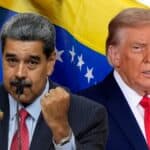
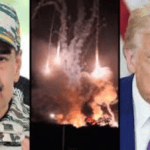
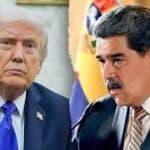
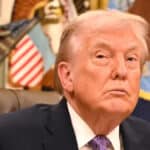
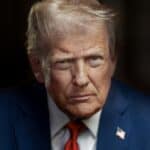
Washington — US President Donald Trump has refused to rule out the possibility of military action against Venezuela, fuelling speculation that Washington could be moving closer to a direct confrontation with the South American nation and its president, Nicolás Maduro.
In an interview with NBC News on Friday, December 19, Trump was asked whether a full-scale conflict with Venezuela was possible. “I don’t rule it out, no,” he said, offering his most explicit comment yet on the prospect of war.
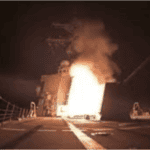
The remarks come amid heightened tensions following an order to significantly expand the US naval presence in the Caribbean. The move followed the seizure of a Venezuelan oil tanker by US forces and the blockade of other vessels linked to Caracas, signalling a tougher enforcement posture toward Venezuelan maritime activity.
These developments build on months of US operations targeting boats in nearby waters that Washington claims were involved in drug trafficking. According to reports, those operations have resulted in dozens of deaths and have drawn international scrutiny and criticism.
The White House has accused the Maduro government of using what it describes as “stolen” oil revenues to sustain an authoritarian regime and of facilitating the flow of illegal drugs into the United States through criminal networks. US officials argue that these actions justify increased pressure on Caracas, including maritime enforcement and sanctions.
President Maduro has strongly rejected the allegations, insisting that US actions are part of a broader campaign to overthrow his government and seize control of Venezuela’s vast energy resources. Caracas maintains that the seizures and blockades violate international law and threaten regional stability.
During the NBC interview, Trump stopped short of explicitly stating whether he intends to remove Maduro from power. “He knows exactly what I want. He knows better than anybody,” Trump said, declining to elaborate further.
Trump also renewed warnings that additional Venezuelan oil tankers could be seized near the country’s territorial waters. “If they’re foolish enough to be sailing along, they’ll be sailing along back into one of our harbours,” he said.
Venezuela holds the world’s largest proven oil reserves, but production has fallen dramatically in recent years due to underinvestment, deteriorating infrastructure and the impact of sweeping international sanctions. Measures imposed by the United States, the European Union and other countries—particularly after the violent suppression of protests in the 2010s—have severely weakened the country’s oil industry and broader economy.
As a result, much of Venezuela’s remaining crude exports are now directed toward China, a shift that US officials view with growing concern amid Washington’s strategic rivalry with Beijing. Analysts say Trump may see Venezuela’s closer ties with China and Russia as a geopolitical challenge in the Western Hemisphere.
“The idea that you have this country, with oil, minerals and rare earths in our hemisphere, and its main allies are China and Russia, doesn’t really align with Trump’s worldview,” said David Smilde, a Venezuela expert at Tulane University.
Despite mounting pressure from Washington, Venezuelan authorities have struck a defiant tone, insisting that US threats, sanctions and maritime blockades will neither disrupt their oil exports nor force political change in Caracas.
Install our app using add to home screen in browser. In phone/ipad browser, click on share icon in browser and select add to home screen in ios devices or add to dock in macos