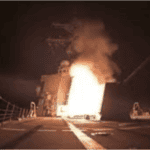
President Donald Trump announced that the United States carried out airstrikes against ISIS militants in northwest Nigeria on Christmas night, describing the operation as a decisive response to what he said were escalating attacks on Christians in the region.
In a post on Truth Social on Thursday, Trump said the strikes targeted ISIS fighters he accused of “viciously killing, primarily, innocent Christians,” warning that further action would follow if the violence continues. “Tonight, at my direction as Commander in Chief, the United States launched a powerful and deadly strike against ISIS Terrorist Scum in Northwest Nigeria,” he wrote. “I have previously warned these terrorists that if they did not stop the slaughtering of Christians, there would be hell to pay, and tonight, there was.”
Trump praised the U.S. military for what he described as “numerous perfect strikes,” adding, “Under my leadership, our Country will not allow Radical Islamic Terrorism to prosper.” He ended his message with a Christmas greeting, saying, “May God Bless our Military, and MERRY CHRISTMAS to all.”
U.S. Africa Command (AFRICOM) later confirmed the operation, stating that the strikes were conducted on December 25, 2025, in Sokoto State, in coordination with Nigerian authorities. According to AFRICOM, the action was carried out at the direction of the president and the secretary of war.
The airstrikes followed sharp warnings Trump issued last month, when he said the United States would take aggressive action if attacks in Nigeria did not stop. Secretary of War Pete Hegseth said the Christmas-night operation fulfilled that warning. “The President was clear last month: the killing of innocent Christians in Nigeria (and elsewhere) must end,” Hegseth wrote on X. “The @DeptofWar is always ready, so ISIS found out tonight — on Christmas. More to come.” He also thanked the Nigerian government for its cooperation.
Alongside military action, the Trump administration has moved to apply diplomatic pressure. Nearly a month after the president’s warning, the administration announced a new visa-restriction policy targeting individuals accused of orchestrating or supporting religious violence against Christians in Nigeria and elsewhere. Secretary of State Marco Rubio said the policy, enacted under the Immigration and Nationality Act, would allow the State Department to deny visas to those who have “directed, authorized, significantly supported, participated in, or carried out violations of religious freedom,” with immediate family members also potentially affected.
“The United States is taking decisive action in response to the mass killings and violence against Christians by radical Islamic terrorists, Fulani ethnic militias, and other violent actors in Nigeria and beyond,” Rubio said.
The measures come amid a surge in attacks on Christian communities and institutions across Nigeria. Last month, gunmen stormed the Christ Apostolic Church in Eruku, Kwara State, killing two people and abducting dozens of worshippers. Although 38 of those abducted were freed nearly a week later, the attack heightened fears among local communities. Days afterward, armed attackers raided St. Mary’s School in Niger State, abducting more than 300 students and staff. While some students managed to escape, hundreds of children and teachers were reported to remain in captivity.
Citing the scale and persistence of the violence, Trump designated Nigeria a “country of particular concern,” a move disputed by the Nigerian government. Speaking to Fox News Radio last month, the president said, “I’m really angry about it. What’s happening in Nigeria is a disgrace.”
Echoing the president’s stance, Rubio said earlier this month that the United States “cannot stand by while such atrocities are happening in Nigeria and numerous other countries,” signaling that both military and diplomatic pressure could continue if the attacks persist.
Install our app using add to home screen in browser. In phone/ipad browser, click on share icon in browser and select add to home screen in ios devices or add to dock in macos