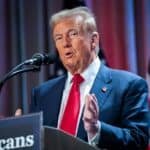
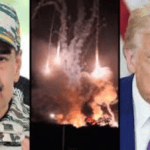
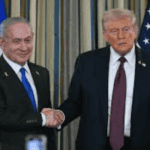
United States President Donald Trump issued a sharp warning to Iran on Friday, January 2, threatening potential U.S. intervention if Iranian security forces continue to fire on protesters, as widespread unrest driven by soaring inflation grips the country. The protests, which have already turned deadly, represent the most serious internal challenge to Iranian authorities in years.
In a social media post, Trump declared that the United States was “locked and loaded and ready to go,” signaling strong support for Iranian demonstrators. His remarks come just months after U.S. forces joined Israel in striking Iranian nuclear facilities in June, targeting Tehran’s atomic program and military leadership.
Iranian officials reacted swiftly and angrily. Ali Larijani, head of Iran’s National Security Council and a senior adviser to Supreme Leader Ayatollah Ali Khamenei, warned that any U.S. interference in Iran’s domestic affairs would destabilize the entire region. Iran maintains influence through allied groups in Lebanon, Iraq, and Yemen, raising fears that escalating rhetoric could spill into broader regional conflict.
Biggest protests in three years
The protests erupted this week over rising prices and a worsening cost-of-living crisis. Demonstrations have spread across the country, with the most intense and deadly confrontations reported in the western provinces of Lorestan and Chaharmahal and Bakhtiari. State-affiliated media and human rights groups say at least six people have been killed since Wednesday, December 31, including one man identified by authorities as a member of the Basij paramilitary force linked to the Revolutionary Guards.
This wave of unrest is the largest Iran has seen in three years, since nationwide demonstrations in late 2022—sparked by the death of a young woman in custody—paralyzed the country for weeks and resulted in hundreds of deaths, according to rights groups. While Iranian authorities have historically suppressed protests through mass arrests and heavy security deployments, analysts say deepening economic pain may now be leaving the government more exposed.
Government response: warnings and dialogue
As Trump’s comments fueled tensions, Iranian officials on the ground signaled a hard line. A senior judicial official in Lorestan warned that “there will be no tolerance for illegal actions that threaten public order and safety,” while state media reported arrests of several “disruptive individuals” in the counties of Azna and Delfan. In Chaharmahal and Bakhtiari, protests have also intensified.
The semi-official Fars News Agency reported that three protesters were killed and 17 injured during an attack on a police station in western Lorestan. Additional fatalities were reported in Lordegan and Kuhdasht, while the Hengaw human rights group cited another death in the central province of Isfahan.
Hengaw also reported that at least 29 protesters were detained during the latest demonstrations, including 14 ethnic Kurds, seven Lors, seven women, and two children.
In contrast to the hardline warnings, Iran’s elected President Masoud Pezeshkian has adopted a more conciliatory tone. Speaking on Thursday, January 1—before Trump’s threat—Pezeshkian acknowledged government responsibility for the crisis and called for dialogue with protest leaders.
“We are to blame… Do not look for America or anyone else to blame,” Pezeshkian said. “We must serve properly so that people are satisfied with us. It is us who have to find a solution to these problems.”
Economic pressure and regional strain
Iran’s economic troubles lie at the heart of the unrest. Inflation has hovered above 36% since March, even by official estimates, while the national currency, the rial, has plunged on the unofficial market. Pezeshkian’s government has embarked on an economic liberalization program, but measures such as partial deregulation of currency exchange have accelerated the rial’s decline, worsening inflation.
Western sanctions tied to Iran’s nuclear program continue to batter the economy, while last year’s Israeli and U.S. strikes have added to pressure on the leadership. Regional developments—including the ousting of Syria’s Bashar al-Assad, a close Iranian ally, and Israeli attacks on Hezbollah in Lebanon—have further strained Tehran’s strategic position.
Iran also continues to back armed groups in Iraq that have previously fired rockets at U.S. forces, as well as Yemen’s Houthi movement, raising the stakes of Trump’s warning.
“American people should know that Trump started the adventurism. They ought to watch over their soldiers,” Larijani said, underscoring the risk that rising tensions over Iran’s internal unrest could ignite wider confrontation.
As protests persist and rhetoric hardens on both sides, Iran faces a volatile mix of economic distress, domestic dissent, and external pressure—conditions that could shape the country’s stability, and regional security, in the weeks ahead.
Install our app using add to home screen in browser. In phone/ipad browser, click on share icon in browser and select add to home screen in ios devices or add to dock in macos